Skip to main content
Back to top
Ctrl
+
K
Documentation
Search
Ctrl
+
K
Search
Ctrl
+
K
Collapse Sidebar
Expand Sidebar
Section Navigation
1. FlagOS Technology Stack Overview
2. Cooperation Level Model
3. Hardware Resource Investment Plan
3.1. Device Investment Evolution
3.2. Key Constraints
4. Adaptation Stages and Execution Plan
4.1. Overall Progress Overview
4.2. Stage 0: Business Kickoff and Contracting
4.3. Stage 1: Development Board Readiness and Base Environment Adaptation (Chip-Level)
4.4. Stage 2: Compiler Adaptation - FlagTree Branch Integration (Entry-Level Threshold)
4.5. Stage 3: Operator Adaptation - FlagGems Coverage (Entry-to-Intermediate Progression)
4.6. Stage 4: Communication and Training/Inference Framework Adaptation (Intermediate Core)
4.7. Stage 5: End-to-End Validation and Legal Compliance (Intermediate Closing Gate)
4.8. Stage 6: FlagRelease Release and Commercial Promotion (Intermediate-to-Advanced Progression)
4.9. Stage 7: KernelGen Adaptation, Automatic Operator Generation, and Operator Competition
4.10. Stage 8: Image Build
5. FlagOS Compatibility Certification System
5.1. Certification Architecture
5.2. Three-Tier Certification Objects
5.3. Certification Levels
5.4. Test Suites
5.5. Certification Process
5.6. Certification Maintenance
6. Distribution Validation System (Draft)
6.1. Distribution Validation Levels
6.2. OS Distribution Validation
6.3. AI Distribution Validation
6.4. Joint Validation Process
6.5. Compatibility Declaration
7. Key Quality Metrics
8. Supporting Skills and Automation Tools
9. Promotion Criteria Checklist
9.1. Requirements for promotion from basic to intermediate
9.2. Promotion from Intermediate to Advanced
9.3. Advanced Cooperation: Deterministic Performance and Quality Requirements
10. Risks and Maintenance
FlagOS Southbound Chip Adaptation Guide: Cloud Chips
3.
Hardware Resource Investment Plan
3.1.
Device Investment Evolution
3.1.
Device Investment Evolution
#
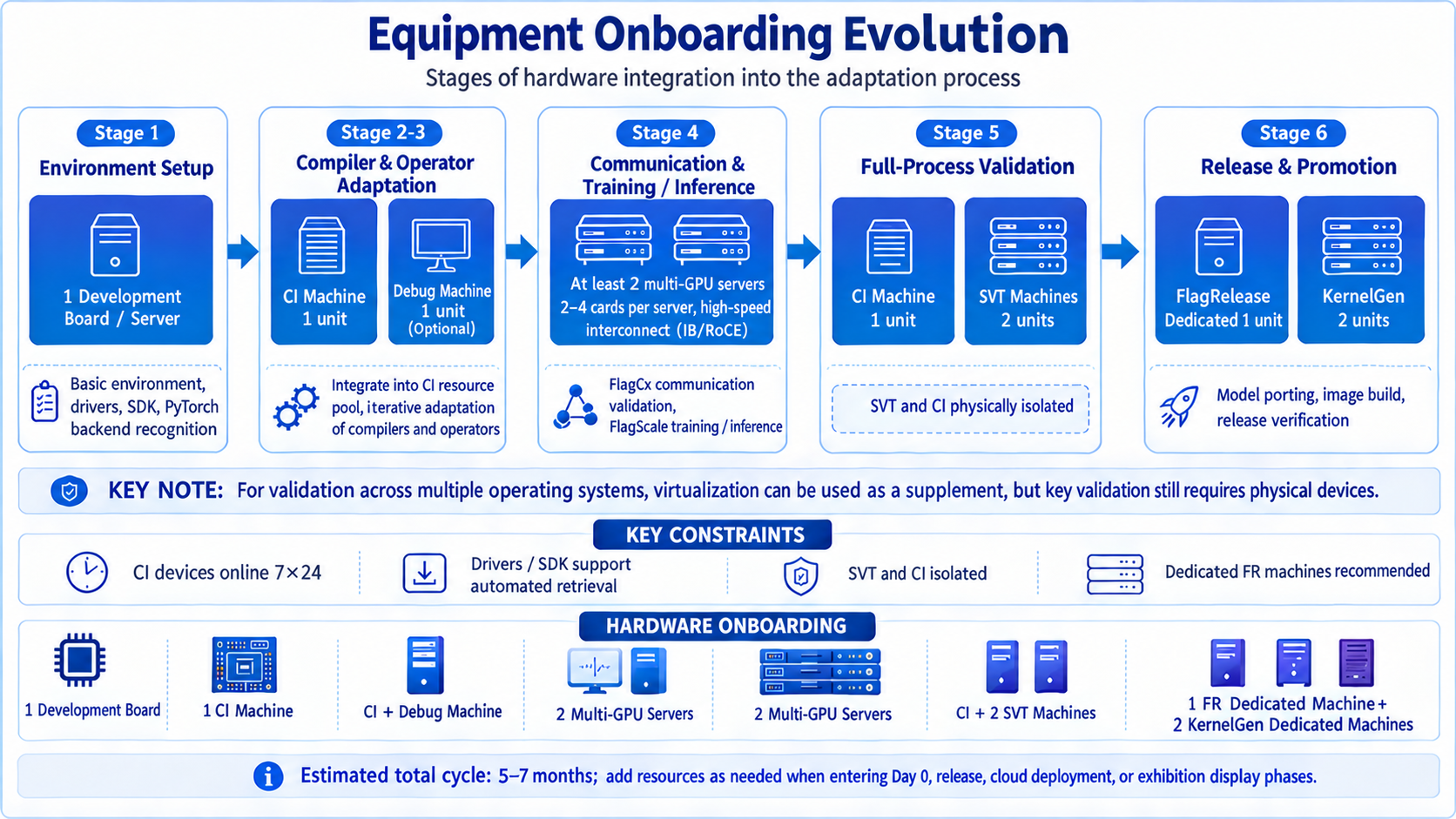
Figure 2. Device investment evolution